You have likely experienced the sensation of staring at a computer screen at 2:30 PM, attempting to force your brain to execute a highly demanding cognitive task. Despite having slept eight hours the night before, the friction is immense. Your focus is fragmented, and your energy is blunted.
Conversely, you have likely experienced windows, perhaps at 9:00 AM after a morning walk, where that exact same task felt completely frictionless. The words flowed, the code compiled, and the data made sense. The difference between these two states is not a matter of willpower, intelligence, or discipline. It is a matter of neurobiology.
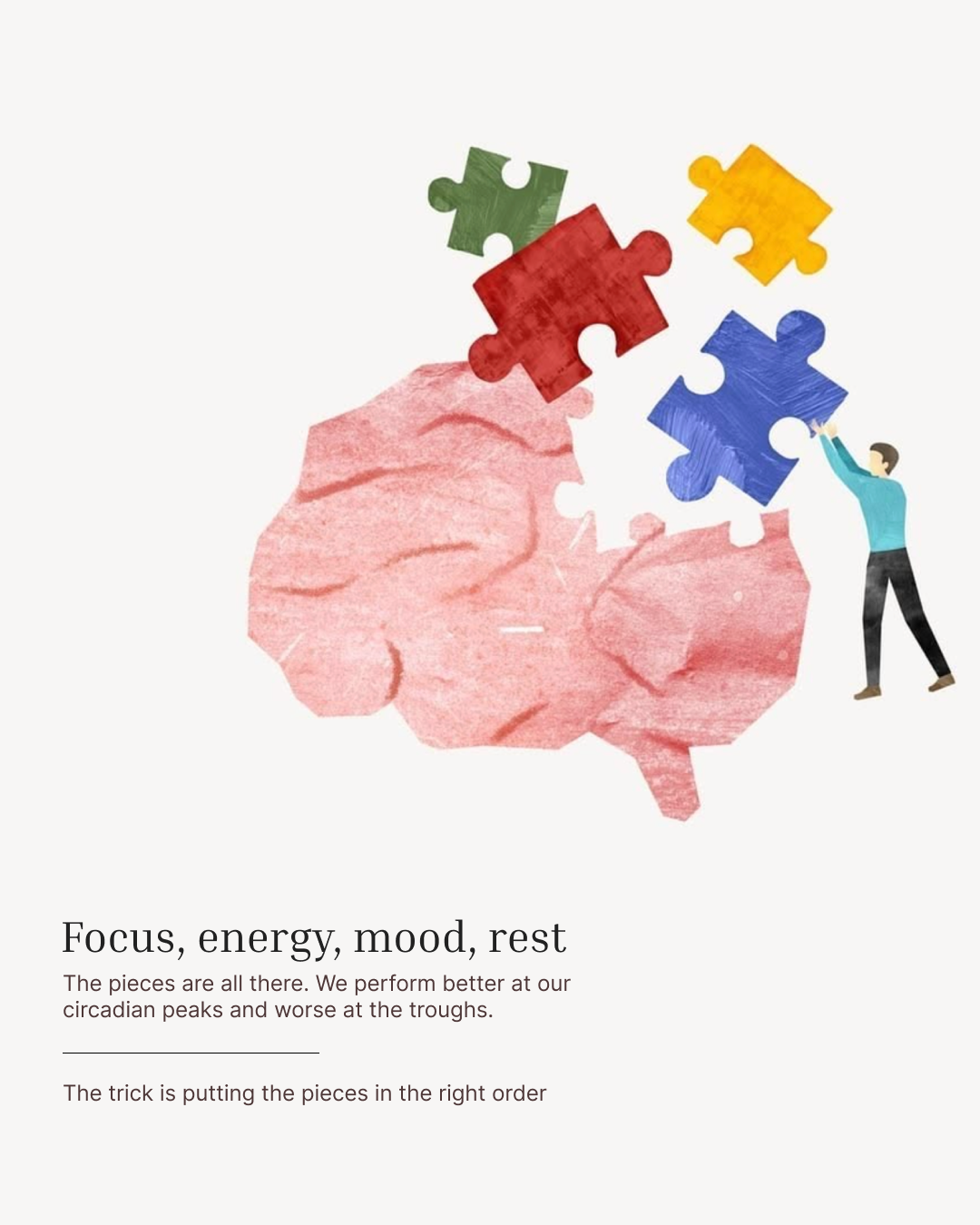
The pieces required for high performance (focus, energy, mood, and rest) are already present within your nervous system. The mistake we make is attempting to force these pieces into time slots where they do not biochemically belong. We perform optimally at our circadian peaks and suffer at the troughs. The trick is putting the pieces in the right order.
The Master Clock and the Two-Process Model
Your brain does not operate in a steady state of alertness. It is governed by a 24-hour internal rhythm orchestrated by a cluster of roughly 20,000 neurons located in the hypothalamus called the Suprachiasmatic Nucleus (SCN). The SCN is the master clock of the human body.
To understand your daily peaks and troughs, we must look at the Two-Process Model of Sleep Regulation. Your alertness is a battle between two forces:
- Process S (Sleep Drive): The steady accumulation of adenosine in the brain. The longer you are awake, the more adenosine builds up.
- Process C (Circadian Drive): The alerting signal generated by your SCN. It sends strong wakeful signals during the day to counteract the rising adenosine.
Piece 1: The Circadian Peak
For the vast majority of diurnal creatures, the steepest rise in the alerting signal occurs in the first few hours after waking. This phase is initiated by the Cortisol Awakening Response (CAR). Within 30 to 45 minutes of waking, your adrenal glands release a sharp pulse of cortisol.
The Application: This is your biological peak. Slot in the "Focus" puzzle piece here. Deep work, complex writing, and high-friction tasks belong in this 90-to-120-minute window. Do not squander it on emails.
Piece 2: The Circadian Trough
Around 7 to 8 hours after waking, almost every human being experiences a significant drop in alertness. While often mistakenly attributed to eating a heavy lunch, this afternoon trough occurs because the alerting signal of Process C briefly dips.
The Application: Attempting to place "Deep Focus" here is biologically inefficient. This is the time to slot in the "Routine" or "Rest" pieces. Administratively light tasks belong here.
Piece 3: The Evening Descent
As evening approaches, the SCN signals the pineal gland to begin synthesizing and releasing melatonin. Melatonin is a timing hormone. It signals to the body that the period of active engagement is over.
The Application: This is the time for the "Mood" and "Rest" pieces. Reading, creative brainstorming without strict parameters, and engaging with family fit perfectly into this neurochemical environment.